
Showing posts with label Internet of Things. Show all posts
Showing posts with label Internet of Things. Show all posts
Sunday, May 18, 2014

Wednesday, May 7, 2014
The Dropbox dilema
Give us your comments on this podcast by Stacey Higginbotham; Peter Semmelhack, CEO and cofounder of Bug Labs.
Are we nearing the Dropbox moment for the internet of things?
Are we nearing the Dropbox moment for the internet of things?

Saturday, May 3, 2014
The IoTea?
I love the IoT. I really do. I truly believe that the world is going to be better off the more connected it becomes. But sometimes digital is just plain unnecessary. Say, boiling water, for instance.
This little gem is a great example of overcomplicating a simple process for no reason at all. Why do I need a Wifi enabled kettle? Even this incredibly enlightening promo didn't really clear it up…
Seriously? €121.79? For hot water? Can anyone anywhere explain to me why this is useful for anyone anywhere?
This little gem is a great example of overcomplicating a simple process for no reason at all. Why do I need a Wifi enabled kettle? Even this incredibly enlightening promo didn't really clear it up…
 |
| WTF? |
Friday, May 2, 2014
Thinking of Launching an IoT Business?
Google up "IoT" and you can see it's already everywhere: from fridges to drones, and whatever you read about the IoT, it will say that the number of devices connected to the Internet is increasing at an alarmingly rapid rate.
When those with an entrepreneurial spirit come across this information, the question probably is: "where is the money?" If you happen to be one of those, check out UK accelerator Springboard, which is betting big time on the IoT by focusing exclusively on the businesses related to the hardware and sensors that connect our everyday Things to the Internet:
When those with an entrepreneurial spirit come across this information, the question probably is: "where is the money?" If you happen to be one of those, check out UK accelerator Springboard, which is betting big time on the IoT by focusing exclusively on the businesses related to the hardware and sensors that connect our everyday Things to the Internet:
So build your team, come up with a cool business idea, polish your pitch and apply to Springboard!
Sunday, April 27, 2014
Is the internet of things going to steal your money?
It’s not unreasonable to say that the IoT is going to change
most of our lives (and probably for the better). It’s also not unreasonable to
say there is probably a lot of money to be made in this market. Which got me thinking, is the IoT going
to make my life easier while it slims my wallet?
Luckily I think the answer is no. As long as I’m willing to
make some small changes, which are probably for the best anyway, I may actually
end up saving money.
Take, for example, this amazing new bulb from Philips.
Now imagine that bulb not only connects to your smartphone
or tablet, but to the grid; reacting to peak energy usage hours by automatically
dimming lights and saving you money while simultaneously reducing overall
stress on the grid. As long as you don’t mind losing a few lumens, your bill
goes down while your community benefits.
In fact, any kind of resource management will probably receive
an overall benefit from the IoT. Waste, water, gas, electricity, and traffic
will be among the first management systems revamped by the IoT. And the cost to
you and me? Nothing, really. Assuming we play by the new rules that will come
with the new systems. Heck, we’re more likely to save money than to lose it. I
know that if I have to pay per pound of garbage in the future, I’m going to be
a lot more careful about the things I throw away. Not only that, my refrigerator
will be in charge of the just-in-time ordering of all my groceries, so there
will likely be less waste anyway.
Of course, the interconnectedness of all things will help
advertisers and marketers in a number of ways. Imagine your fuel band knows
exactly how many miles you’ve run since your last purchase of $99.99 at the
Nike store, and it knows those shoes have a life of 400 miles. How far do you
think you’ll have run before you start getting notifications that it’s time for
a new pair? The good news is your stuff probably won’t be able to spend your
money without your okay. The bad news is that the world of advertising just
weaseled its way into your entire connected life.

If you’re keen to know which companies are making strides in
the IoT, check out this list.
Sunday, April 20, 2014
Internet-connected cars
The first
thing that comes to my mind when I think about the Internet of Things is the
speech of Bill Ford, executive chairman of Ford Motors Company, on TED from
March 2011 where he talks about his vision of how technologies can reduce air
pollution by minimizing traffic jams and time spent on finding parking spots.
Amongst different technologies he
mentioned I would like to talk about two concepts
that inspired me the most.
·
Smart
Vehicle Network Cars communicate to each other
and the vehicle that hits a traffic jam sends signals to vehicles behind it so
they can reroute before it’s too late.

·
Smart
Parking System A
network that connects parking slots and cars (or smartphones) and shows all
free parking places in your neighborhood and you can book one in advance.
I tried to find if
there has been any progress in the implementation
of the above-mentioned concepts. Especially in the
area of Smart Vehicle Network, that was being tested at the time. And indeed
Ford Motors organized an event in June 2011 where it presented a demo version
of the talking car tech, but announced
that technology will not be available for use untill 2016. But will other car manufacturers
accept this standard if Ford can successfully implement the technology in its
vehicles? Or each of them will try to create their own platform. Situation
becomes more interesting because recently wireless
carriers, such as Verizon and AT&T,
already started to invest in connected-car technologies. May be we will see new
battle for the industry standard very soon.
I found a
company that already offers a working Smart
Parking System called FastPrk.
Video: Smart Parking
Video: Smart Parking
The system works based on sensors embeded in
each parking bay in the street. When a car is parking or leaving, information
is being sent and updated in database (more details in the picture below) .

Those
who drive in cities can't underestimate benefits of this system. Now it is turn
of city municipalities and companies that operate paid parkings to make this a
reality. Implementation of this kind of systems is benefitial for drivers
because they waste less time on seeking parking spaces, for operators of
parkings because they can increase utilization rates, and for whole population
because of less air pollution.
Monday, April 14, 2014
Keeping cool with the Internet of Things
The cold bothers me. Living in Melbourne my house was never warm so
that bothered me greatly.
I remember driving home on cold winter nights, snug in the heated
interior of my car, and dreading arriving home to my cold, unheated house. I
would huddle in my car outside the door, working up the courage to leave the
comforts of the heated cabin and wishing that SOMEHOW, the heating would have
been turned on and my house would be warm.
And then there were those days Melbourne’s temperature dropped by
more than 20°C in an hour. I might be
out and about in a summer dress, when the heavens would open and the temperature
would drop faster than I could ever imagine. I’d scurry home, again wishing
that SOMEHOW, my heating would be on and my house warm.
There was a solution to the first of my problems. I could leave the
heaters on all day - neither an environmentally sound nor, given the exorbitant
cost of electricity in Victoria, a budget friendly option. I could install timers on the heaters, and
set them to turn on at a particular time.
While useful, this was still not ideal – I was rarely home at the same
time every night, and so would overuse. I had never come across a solution to
the second of my problems.
Until I heard of NEST, a business that uses the Internet of Things
to provide a solution to both of my problems.
NEST offers a thermostat that links your home’s heating and cooling
devices to the internet. You can then
access your account over the internet to adjust the temperature of the home.
Imagine working late, and being able to turn your heating on with
your smartphone just as you leave work, arriving home to a nice, warm house
without unnecessary electricity costs. Or being able to turn on your air-conditioning
while mobile at just the right time, so the house is cool when you arrive home. Or going on holiday, and forgetting to turn
off the pre-programmed heating or cooling – now simply turn it off from your
phone.
But the benefits of NEST don’t stop there.
NEST developers recognize that programmed thermostats give excellent
electricity savings, but that few people program their thermostats to achieve
the cost savings. And so they made the
NEST device smart. In the first few days of use, it learns your schedule
and what temperatures you like at what times. It then creates a personalized
schedule, automatically adjusting the thermostat so you don’t need to.
Combined with the ability to control your device from outside the
home, this equals serious electricity cost savings. NEST estimates that this system can reduce
heating and cooling costs by around 20%.
At Australia’s prices, that’s a significant amount of money.
And I’m not the only one who is impressed by NEST – Google just
handed over $3.2 billion to acquire the company in a bid to move into the home
automation market.
Clearly Google valued the nascent technologies and vision of NEST’s
founders more than the immediate opportunity of a smart thermostat. This is why
it will be so interesting to follow where Google and NEST move next, and which
home devices they are able to make a part of the “The Internet of Things”.
Sunday, April 13, 2014
Sunday, April 6, 2014
Your fridge will soon buy your groceries!
Today,we are going to talk about food (I love food!), and how IoT (Internet of Things) can help food businesses to expand their operations and increase the number of point of sales in an economically efficient way.
An American start up called Pantry provides food companies with a very smart business solution to sell their products unattended/without staff.
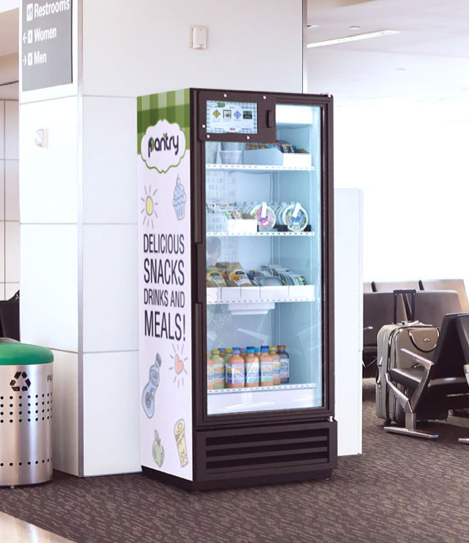
You can discover their product in the following video:
The “intelligent” fridge uses the RFID technology to charge the customers. They will be billed what they removed from the fridge.
Value is not only added for the customer, who can assess and check the food before actually buying it, but for the company too. Indeed Pantry provides its customers with analytics enabling the food providers to optimize restocking, identify trends, and ensure freshness. They also provide up to minute inventory and sales data. This data will be used to optimize operations and increase both customer satisfaction and profits.
In the near future we can imagine a company like Corte Ingles in Spain (of Whole Foods in the USA). To develop the same kind of technology where a customer would fill in a database their standard fridge inventory, and every week Corte Ingles would only refill the items that are no longer recorded as being in the fridge. The company could also send text messages to the customers when there is a shortage of an item in fridge reminding them to do pick it at the store.
Sunday, March 23, 2014
Improved Service, Happier Customers
Nowadays, most Internet of Things devices in
the market serve consumers and allow us to have a “connected life” we could of
only dreamed of a decade back. From tapping on our smartphones miles away from
our home we can control heating and air conditioning, switch the lights on or
off, and see if someone has really broken into our place when the alarm went
off or if its just the neighbor’s cat sneaking into our kitchen. Although this
undoubtedly is pretty cool, and makes us, normal consumers, feel as we’re living
in the age of the Jetsons, the power of the IoT goes way, way beyond the
confines of our personal lives, and is of great use for enterprises, especially
service providers. Devices connected to the Internet will allow these kind of
companies to closely monitor how much of their service we actually consume, and
constantly and immediately modify their offer according to our behavior.
Progressive Auto Insurance, in the United
States, is one of these companies that have capitalized on the IoT. As its name
implies, Progressive sells car insurance, and used to calculate consumers’
insurance premium based on their credit score, assuming that those of us who
were responsible spenders, were also responsible in other areas of our lives,
including how we drive. This represented losses to Progressive every time they
insured a person smart with their money but wreckless with their driving, and
also led them to overcharge a person burdened by loans on a house they just
bought, but great at the wheel. The solution:
yes, ladies and gentlemen, the IoT!
When Progressive realized that credit score and
driving behavior were not always correlated, they began to offer their clients
a “Snapshot”, which consists on having a small device plugged into the USB port
of their car, and monitoring how they drive in order to calculate a more
accurate insurance premium. This device is in constant interaction with
Progressive’s Control Center, where they keep track of how you’re driving.
Things such as distance driven, how many times you hit the brakes hard, and the
number of miles you drive between midnight and 4am, make you a higher risk
client, and increase the premium they will charge you next year. But, for
example, if you mostly use your car for your short, daily commute to the office,
and are, in general terms, a responsible driver, the IoT could represent a
saving of up to 30% on your car insurance. And, let’s be honest, who doesn’t
want to save some cash without drastically changing their daily habits?

The question now being asked is if this will
become an industry standard. Assuming we’re responsible drivers, we will be
lured by the possible discount we can get from our insurance company if they
monitor our driving. But, even though Progressive says that they are not
tracking your speed or your location, the fact that if they wished they could
makes us a little iffy about it. In the
end, as with most debates concerning IoT, it all boils down to how protective
we are with our privacy. But, if we trust the companies with which we do
business, as we have been doing for centuries, the IoT will allow them to
tailor their product offering to our specific need; which, in the end, will do
more good than harm in our daily lives.
Sunday, March 16, 2014
eHealth - ‘Humanization of Technology’

In healthcare, the possibilities are so great, that we really
need to imagine a few finite use cases to prioritize and illustrate likely,
near-term scenarios. Today, more than one billion adults worldwide may be
classified as obese, a condition in which their weight imperils their health.
Imagine a wrist or armband that senses vital signs such as pulse, blood
pressure, red blood cell counts, and glucose and cholesterol levels—can even
monitor activity levels. If walking is a prescribed benefit, the user might be
reminded to do so. If medications should be taken at intervals, the user might
be alerted to optimal timing. Home, office or mobile devices like smartphones,
tablets, laptops and computers might provide the robust connectivity needed for
accessing a patient’s medical history, uploaded by a medical professional or
fitness advisor, where the medical device could synthesize it into health
advisories or alerts.

The likely outcome of these advancements is greater access to better patient care, reduced costs and, ultimately, longer, healthier lives due to the disease prevention and management. As no one entity will have the expertise or capital to develop this emerging vision of the IoT and its application across so many vertical markets, an ecosystem of partners must evolve to bring products and services to market. But there’s little doubt that advancements now in the works will revolutionize medicine, as it has computing and communications. Finally, the “humanization of technology” will offer that longer, better life we’ve all dreamed of.
Subscribe to:
Posts (Atom)